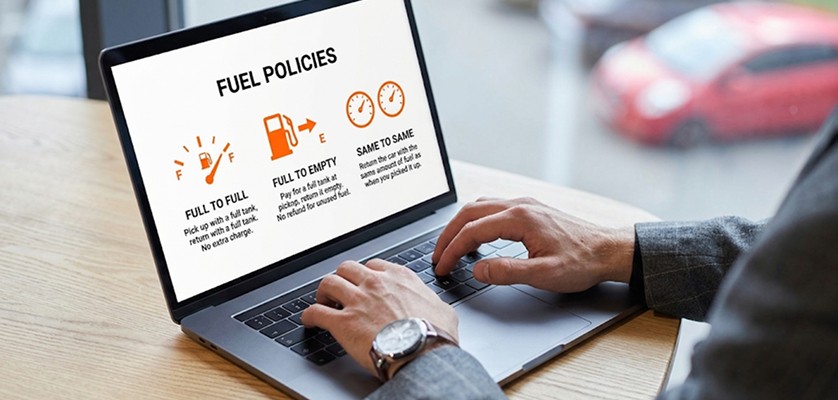
Browsing car rental deals and getting confused between different fuel policies is a common issue, especially for first-time renters. Initially, each policy sounds reasonable, until the final bill arrives with additional charges.
Knowing the difference between them and understanding the basic terms will help you make smart decisions. In this blog, we cover exactly that & more. So, keep reading.
What is a full-to-full fuel policy?
A full-to-full is a car rental fuel policy where you receive a rental car with a tank that is either fully charged or has a full tank of fuel. The hirer has to return the car with a tank full of fuel.
For example: You are renting a car with a full fuel tank of 40 liters (10.6 gallons) under a full-to-full fuel policy for a 5-day trip. By day 5, you have exhausted 30 litres (7.9 gallons) of fuel. Before returning the rental, refuel the tank with the missing amount; otherwise, additional charges will be levied.
Suitable for:
- Long-distance travelers
- Budget-friendly travelers
- Organized travelers
Who should avoid:
Travelers with a tight schedule or whose drop-off location is far from the last fuel station. It could create unwanted stress.
What is a same-to-same fuel policy?
With a same-to-same policy, you will have to return the car with the same amount of fuel as it was at the beginning. Any unused fuel won't be refunded, and if the fuel level is less than the amount provided, a fee may be charged.
Suitable for:
- Short-term renters
- Travelers who want to avoid pre-filling hassle
Who should avoid:
Long-distance travelers and people who are on a hectic schedule.
What is a full-to-empty fuel policy?
Also known as a Fuel Purchase Option (FPO), under this, you will get a rental car with a full fuel tank, and you can return it empty. If there is any unused fuel, generally it won't be credited back.
Remember: The initial fuel refill rate will be slightly expensive, as rental companies add additional fees to the overall amount. If you are looking for a budget-friendly policy, you may want to consider other options.
Suitable for:
- Tight-schedule travelers
- Who want to board a flight at the end of their trip
Who should avoid:
People planning short trips who won't use the full tank.
Full-to-full vs. other options: A quick overview
| Fuel policy | Cost | Where you pay for the fuel | Return goal | What to keep in mind |
|---|---|---|---|---|
| Full-to-full | $0 (Built into base rental rate) | At a nearby local gas station before returning | Return the tank full | Keep the tank full, or you might have to pay a fee |
| Same-to-same | $0 (No charge during pickup) | At a nearby local gas station before returning | Return the tank with the same level of fuel | A fee will be charged if the fuel level is lower than the initial level |
| Full-to-empty | Amount charged at the rental desk/counter | To the car rental supplier at the desk/counter | Return with an empty tank | You won't be paid back for unused fuel |
Important points to consider related to fuel policy with your car rental
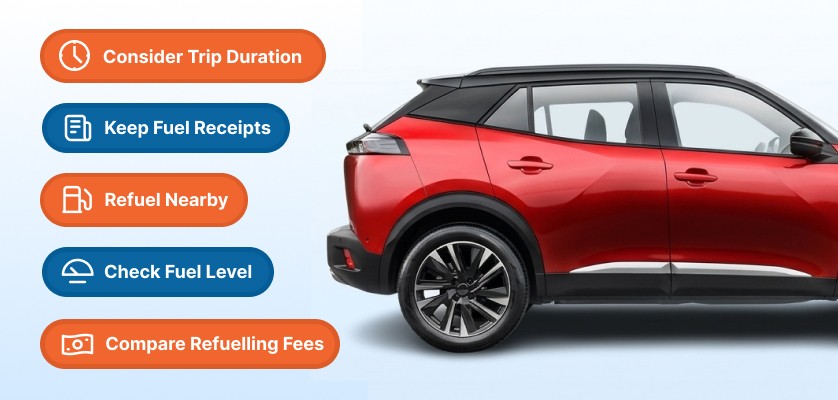
- Consider the length of your trip: The distance you will be traveling also influences the type of policy you should choose. For example, if you are planning to travel around New York City only, then the same-to-same policy will be better suited for you. For long trips, let's say from New York to Niagara Falls, a full-to-full policy can be an optimal choice.
- Keep the receipts safe: If you have refuelled just before returning your rental, keep that receipt safe. Sometimes the supplier may ask for it to handle any query related to fueling charges.
- Refuel near the return location: Before beginning your journey, locate all the fuel stations nearby. This way, you will know the exact spot to refuel the tank before dropping off.
- Check the fuel gauge: Before driving away with your rental, check the fuel level on the gauge and compare it with the rental agreement. If there is any mistake, talk to the supplier and get it corrected.
- Compare the supplier's refueling fee: If you are choosing a full-to-full or same-to-same fuel policy and you return the tank with less fuel, the supplier will charge you an additional refueling fee. As this additional cost differs by supplier, choose the policy, compare the price, and then see which option fits within your budget.
How to choose the right fuel policy?
Now that you have enough information about what the policy is, here are some tips to save money and have a convenient experience:
- Think about the mileage: Before choosing a fuel policy, do a rough calculation of how many kilometers you would travel, the expected fuel consumption, and the cost of fuel in local currency.
- Check refund terms: Every supplier has their own fuel policy terms & conditions. Before booking your car rental, make sure to go through them and choose according to your requirements.
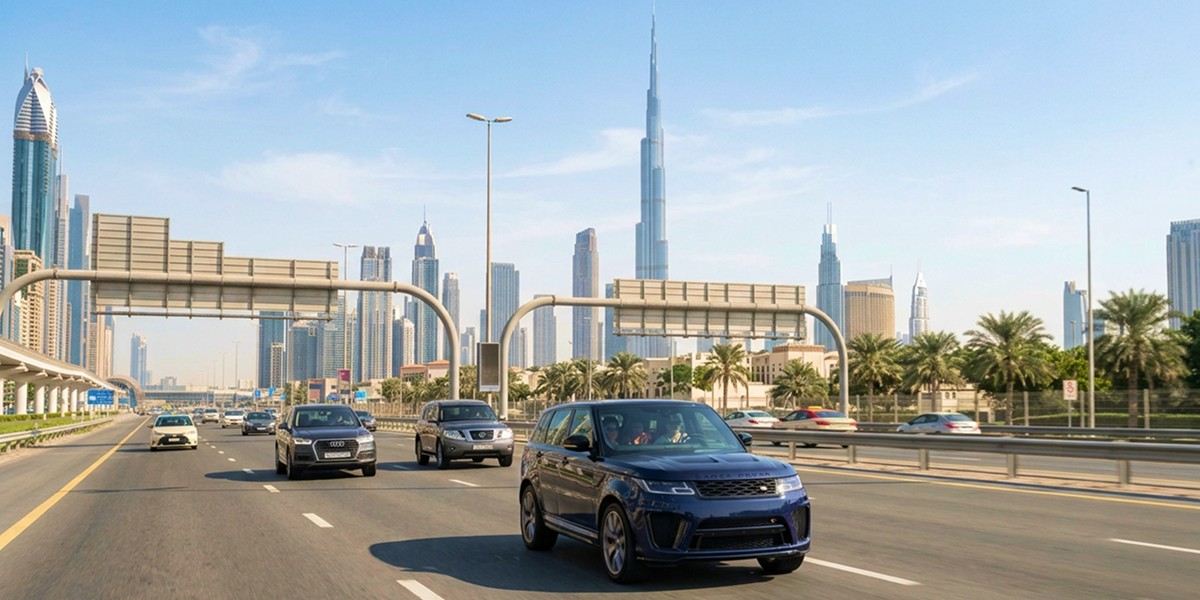
Consider return plans: Your return plans also play a key role in deciding which fuel policy will work with your trip. For instance, if you are travelling from Dubai to Abu Dhabi, the one-way distance is 116 km, which will take you around 1 hour 30 minutes approx. to travel.
On your way back, you will be traveling the same distance, so you may have to stop for refueling. If you are on a tight schedule, locating a fuel station right before your drop-off could be hectic. Choose a policy that keeps your journey stress-free and doesn't end up increasing your rental cost.
Full-to-empty fuel policy vs prepaid fuel: Are they same?
Many renters often confuse these terms. Although they have a similar payment structure i.e., you pay for the fuel upfront they differ in terms of need and other factors.
| Point of difference | Full-to-empty | Prepaid fuel |
|---|---|---|
| Requirement | It is a mandatory fuel policy that is provided by many suppliers. | It is an optional add-on that you decline. |
| Pricing | Included in the rental cost & varies by supplier. | Prepaid fuel cost is almost similar to the local market rate or at a discounted price |
| Refunds | Usually no refunds, but some suppliers may offer a partial refund. | No refunds |
| Suited for | As it's chosen online while booking a rental, reasons to choose this policy would be way different than the reasons to choose prepaid fuel. | As it's an impromptu decision, it's mostly suited when you don't have time to fuel up after the pick-up. |
Final takeaway
Choosing a fuel policy requires more than just understanding the terms. You need to factor in all the possibilities, deadlines, and the whole itinerary to finally pick one. Each fuel policy has its own set of pros and drawbacks, so have a clear understanding of that.
At the end, it all depends upon the type of trip you are taking and the flexibility of your plans. Your options open up more when you have enough time on your hands.
FAQs
Is full-to-full better than full-to-empty fuel policy?
Yes, the full-to-full fuel policy is better than the full-to-empty fuel policy as the former is less expensive. But there are plenty of factors that a renter should look into while choosing a policy in addition to the cost.
What happens if I choose a full-to-full policy and return the car without a full tank?
You will have to pay a missing fuel fee at the return location, which might be more expensive than refueling at the local station.
What will be the best fuel policy option if I am planning a short trip?
For short trips, the same-to-same fuel policy is better. When returning, you will only refill the exact amount of fuel that you used, so you won't waste money on paying for extra fuel.
Do I get a refund for unused fuel?
No, the car rental supplier won't pay you back for any unused fuel in most cases. That's why you should choose your fuel policy, keeping in mind the travel timeline.
























































































'%3E%3Ccircle cx='0' cy='0' r='7' fill='%23fff'%3E%3CanimateTransform attributeName='transform' type='scale' begin='-0.24691358024691354s' calcMode='spline' keySplines='0.3 0 0.7 1;0.3 0 0.7 1' values='0;1;0' keyTimes='0;0.5;1' dur='0.6407407407407407s' repeatCount='indefinite'/%3E%3C/circle%3E%3C/g%3E%3Cg transform='translate(50 50)'%3E%3Ccircle cx='0' cy='0' r='7' fill='%23fff'%3E%3CanimateTransform attributeName='transform' type='scale' begin='-0.12345679012345677s' calcMode='spline' keySplines='0.3 0 0.7 1;0.3 0 0.7 1' values='0;1;0' keyTimes='0;0.5;1' dur='0.6407407407407407s' repeatCount='indefinite'/%3E%3C/circle%3E%3C/g%3E%3Cg transform='translate(75 50)'%3E%3Ccircle cx='0' cy='0' r='7' fill='%23fff'%3E%3CanimateTransform attributeName='transform' type='scale' begin='0s' calcMode='spline' keySplines='0.3 0 0.7 1;0.3 0 0.7 1' values='0;1;0' keyTimes='0;0.5;1' dur='0.6407407407407407s' repeatCount='indefinite'/%3E%3C/circle%3E%3C/g%3E%3C/svg%3E)


